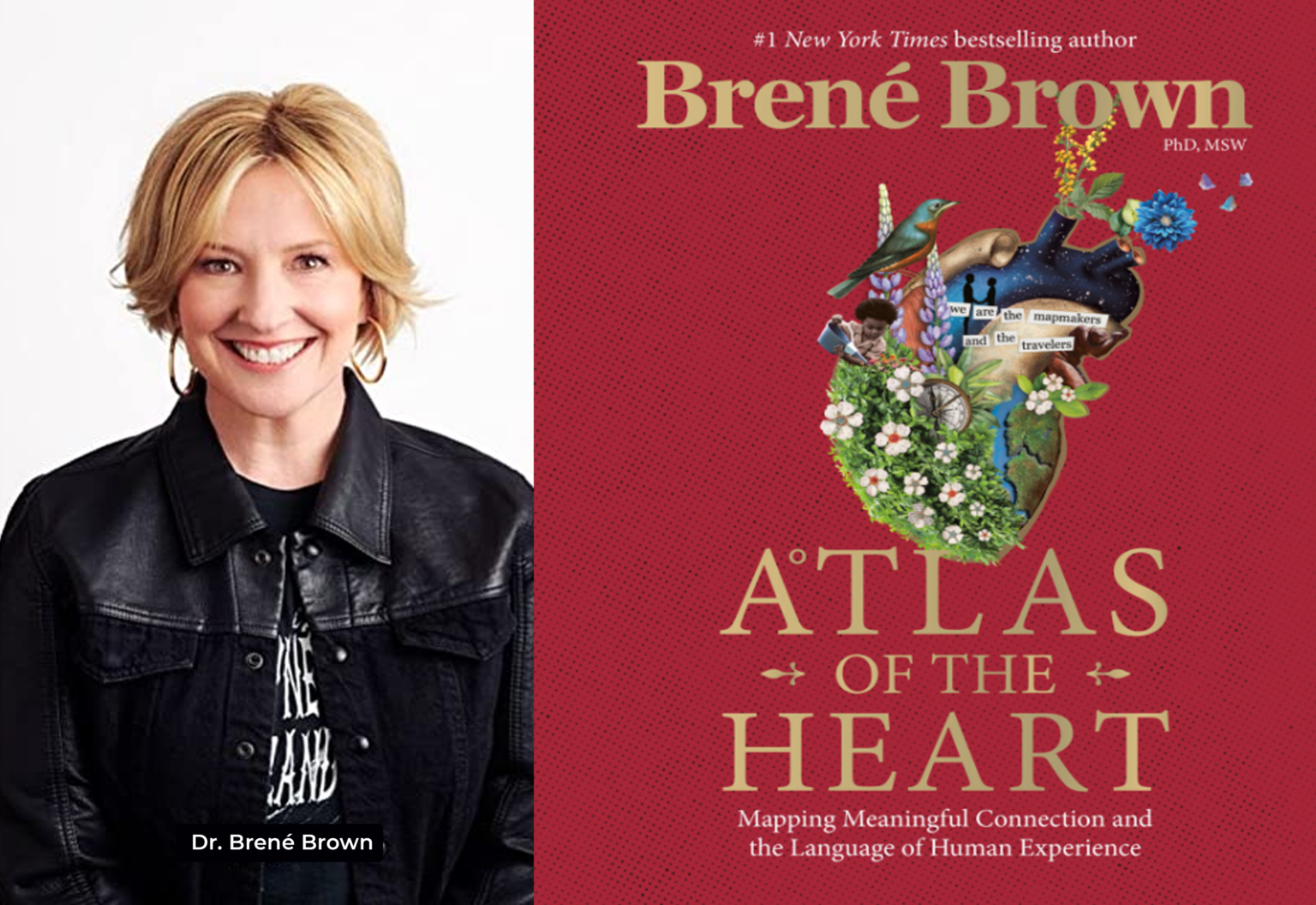
Many clients ask, does naming emotions reduce shame? The answer is often yes…
What Brené Brown’s Atlas of the Heart Teaches Us About Healing
Many people come to counselling saying some version of the same thing:
“I don’t know what I’m feeling, I just know it doesn’t feel good.”
They may describe stress, anxiety, numbness, or overwhelm, but when asked to go a little deeper, words disappear. This isn’t because they lack insight or self-awareness. It’s because most of us were never taught how to understand our emotional world, only how to manage or suppress it.
As Brené Brown so powerfully explores in her book Atlas of the Heart, our ability to make sense of our emotions shapes how we move through the world, how we relate to others, and how we care for ourselves.
Emotions Need Language to Be Understood
In Atlas of the Heart, Brené Brown describes emotions as experiences that require language, context, and meaning. When we don’t have the words for what we’re feeling, we often default to broad labels like “stressed,” “fine,” or “overwhelmed.” While these words are familiar, they rarely capture the full picture.
Brown reminds us that there is a meaningful difference between:
Stress and overwhelm
Sadness and grief
Anxiety and fear
Shame and guilt
When emotions go unnamed or misunderstood, they tend to show up in other ways, tension in the body, emotional shutdown, irritability, people-pleasing, or self-criticism. Naming emotions doesn’t make them disappear, but it does make them less isolating and more manageable.
Understanding Emotions Builds Self-Compassion
One of the most impactful ideas in Atlas of the Heart is that emotions are not problems to solve; they are signals to understand. When we mislabel or judge our emotional experiences, we often turn against ourselves.
For example, someone might say, “I’m just being dramatic,” when they are actually feeling disappointment or grief. Or “I shouldn’t feel this way,” when the emotion makes complete sense given their experiences.
Learning the language of emotions helps shift the question from:
“What’s wrong with me?”
to
“What is happening inside me, and why?”
That shift is where healing begins.
Why This Matters in Therapy
In counselling, emotional understanding isn’t about analyzing every feeling or becoming emotionally “perfect.” It’s about developing a relationship with your inner world that is curious rather than critical.
When clients learn to identify and name emotions more accurately, they often notice:
Greater emotional regulation
Reduced shame and self-blame
Improved communication in relationships
A deeper sense of self-trust
As Brown emphasizes, emotional literacy allows us to move through life with more clarity and connection, both with ourselves and with others.
A Moment to Pause and Check In
As you read this, you might take a moment to gently notice what’s present for you right now.
Try this brief reflection:
What emotion best describes how you’re feeling in this moment?
If that emotion could speak, what might it be asking for?
Can you offer yourself curiosity instead of judgment?
You don’t need to change anything; simply noticing is enough.
You Don’t Have to Do This Alone
Learning the language of emotions can feel vulnerable, especially if you’ve spent years minimizing or ignoring how you feel. Therapy can provide a safe, supportive space to explore emotions at your own pace, without pressure or expectation.
As Atlas of the Heart reminds us, understanding our emotions is not about control; it’s about connection. And connection begins with feeling seen, heard, and understood.
If this topic resonates with you, support is available. You deserve a space where your emotions make sense, and where you don’t have to navigate them alone.
The Purpose of Our Emotions

Anxiety
Purpose: Alerts us to uncertainty and potential threat
Anxiety shows up when the future feels unpredictable or unsafe. Its role is to help us prepare and protect ourselves. When it becomes chronic, it often signals that our nervous system has been on high alert for too long, not that we are weak or incapable.
Fear
Purpose: Protects us from danger
Fear is our body’s immediate response to perceived risk. It sharpens awareness and mobilizes action. Fear becomes overwhelming when past experiences teach the body that danger is everywhere, even when the present moment is safe.
Stress
Purpose: Helps us respond to demands
Stress gives us the energy to meet challenges and responsibilities. Short-term stress can be motivating. Long-term stress, however, tells us that our capacity has been exceeded and that rest, boundaries, or support are needed.
Overwhelm
Purpose: Signals too much input and not enough capacity
Overwhelm occurs when demands outpace our emotional, mental, or physical resources. It’s a sign to slow down, simplify, or seek support, not a sign of failure.
Shame
Purpose: Attempts to protect belonging
According to Brené Brown’s research, shame emerges from the fear of disconnection, the belief that we are unworthy of love or belonging. While shame tries to keep us acceptable in the eyes of others, it ultimately isolates us. Naming shame is one of the most powerful ways to reduce its grip.
Guilt
Purpose: Guides our values and accountability
Guilt shows up when our actions don’t align with our values. Unlike shame, guilt can be constructive; it helps us repair, apologize, and grow. It becomes harmful only when it turns into self-punishment instead of self-reflection.
Sadness
Purpose: Signals loss and invites care
Sadness allows us to acknowledge loss, disappointment, or unmet needs. It slows us down and invites comfort, connection, and compassion from ourselves and others.
Grief
Purpose: Honors love and attachment
Grief exists because something meaningful mattered. It’s not something to “get over,” but something to move through. Grief reminds us of our capacity to love deeply.
Loneliness
Purpose: Signals the need for connection
Loneliness is not the absence of people, but the absence of meaningful connection. It prompts us to seek understanding, belonging, and shared experience.
Anger
Purpose: Protects boundaries and highlights injustice
Anger often arises when boundaries are crossed or values are violated. When understood, it can guide assertive communication and change. When suppressed or misdirected, it can turn inward as resentment or shame.
Joy
Purpose: Reinforces connection and meaning
Joy signals moments of presence, gratitude, and connection. Brené Brown notes that joy can feel vulnerable, especially for those who have experienced loss, because it reminds us of what we care about.
A Gentle Reminder for You
Emotions are not instructions; they are a form of information.
They are not proof that something is wrong with you; they are evidence that your system is responding to your experiences.
Learning to understand emotions, rather than judge them, is a powerful step toward healing.
Reference:
Brown, B. (2021). Atlas of the Heart: Mapping Meaningful Connection and the Language of Human Experience. Random House.