

Anxiety Therapy and Counselling in Whitby
Virtual appointments across GTA and Durham Region
Anxiety can feel overwhelming, like a constant weight on your chest or a relentless voice of worry in your mind. Through anxiety therapy and counselling in Whitby tailored to your unique experience, the professionals at Intentional Growth Path can help you regain control, quiet the noise, and find lasting relief.

What Anxiety Feels Like
Living with anxiety can feel exhausting. Your thoughts may never slow down, your body feels tense, and there’s a constant sense that something is about to go wrong, even when you can’t explain why. It wears you down, and it makes sense that you just want some relief.
Nothing is wrong with you. Anxiety is your nervous system doing its best to protect you, even when it’s working overtime. Therapy can be a powerful step toward calming your mind, reconnecting with your body, and feeling more at ease in your relationships, with your family, at work, with your partner, and with yourself. Starting therapy is a big step in Managing Anxiety.
Common Signs and Symptoms
Do you feel stuck in a cycle of constant worry or overthinking?
Does your mind replay conversations, fears, or “what ifs” on a loop?
Is your inner voice overly critical, judgmental, or hard to quiet?
Do everyday responsibilities feel overwhelming or heavy to face?
Are you restless, on edge, or having trouble falling or staying asleep?
Do you often feel tense or unsafe, even when there’s no clear reason?
Are you feeling drained or burnt out, no matter how much rest you get?
Do you notice irritability or emotional outbursts showing up in your relationships?
You may not be able to name exactly what’s wrong, you just know something doesn’t feel right, and you’re exhausted from carrying it. If this resonates, working with an anxiety therapist could be a supportive next step.

Finding the Best Remedy for Anxiety
Many people search for the best remedy for anxiety, hoping there’s a single solution that will finally bring relief. The truth is that anxiety isn’t one‑size‑fits‑all, and the most effective remedy is one that’s tailored to you, your history, your nervous system, and the patterns you’ve learned to survive.
The most effective approach is usually a combination of strategies that help you understand what your anxiety is trying to protect you from, while also giving you tools to feel calmer and more grounded.
Many people find relief through a mix of:
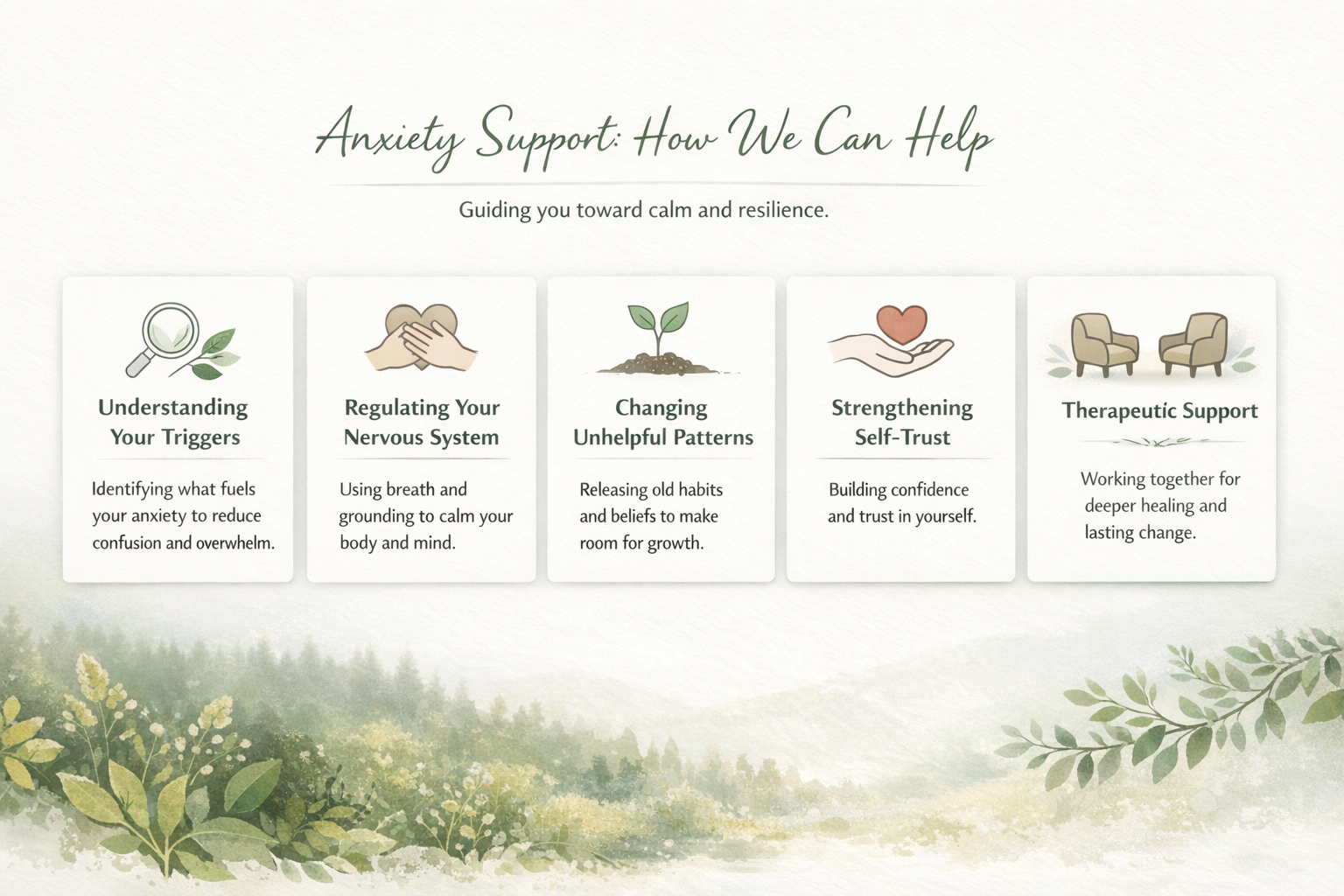
• Understanding your triggers — noticing what your anxiety responds to can reduce the confusion and overwhelm.
• Nervous system regulation — practices like slow breathing, grounding exercises, and mindful attention help your body shift out of fight‑or‑flight.
• Changing unhelpful patterns — exploring old beliefs, protective behaviors, and emotional habits makes room for new ways of coping.
• Strengthening self‑trust — anxiety often quiets when you feel more capable of meeting life’s challenges.
• Therapeutic support — talking with someone trained in anxiety and trauma can help you access deeper healing, not just surface‑level coping.
The “best remedy” is ultimately the one that helps you feel more in control of your inner world, less ruled by worry, and more connected to yourself. Effective anxiety care isn’t about forcing yourself to be calm; it’s about understanding what your mind and body are trying to do for you and learning steadier ways to respond.


When to Seek Professional Help
If anxiety is impacting your relationships, work, or day-to-day functioning, it may be time to consider professional counselling for anxiety. With the right guidance, you can feel more grounded, supported, and in control.
Benefits of Anxiety Therapy
Anxiety therapy isn’t about “fixing” you, it’s about helping you feel safer, calmer, and more in control of your life. With the right support, many people begin to notice meaningful changes, such as:
✔ A quieter mind and fewer spiraling or intrusive thoughts
✔ Tools to manage worry, panic, and stress when they show up
✔ Better sleep and less tension in your body
✔ Increased confidence in your ability to cope with everyday challenges
✔ Healthier boundaries and improved communication in relationships
✔ A more compassionate inner voice and reduced self-criticism
✔ Feeling more present, grounded, and connected to yourself
✔ A greater sense of ease and trust in your day-to-day life
Over time, therapy can help you understand your anxiety, respond to it with care, and create lasting changes that support your well-being, at work, at home, and within yourself.

Therapy for Anxiety That Fits You
Anxiety isn’t one-size-fits-all, and therapy shouldn’t be either.
Your experience is unique, shaped by your story, your relationships, and the pressure you carry. Our work together will be tailored to what you’re actually going through, so support feels relevant, practical, and grounding.
Generalized Anxiety (Constant Worry & Overthinking)
If your mind rarely slows down, replaying conversations, anticipating worst-case scenarios, or scanning for what might go wrong, you may feel mentally exhausted but unable to switch off.
Together, we’ll work on calming the spiral of overthinking, building tools to stay present, and helping your nervous system feel safer in everyday life.
Social Anxiety
Do you worry about being judged, misunderstood, or not “measuring up”?
Social anxiety can make even simple interactions feel draining or high-stakes.
In therapy, we gently untangle those fears, strengthen self-trust, and build confidence so you can show up more authentically, without the constant inner critic running the show.
Panic Attacks
Panic can feel sudden, intense, and frightening, with a racing heart, shortness of breath, dizziness, or a sense that something is terribly wrong.
We’ll focus on understanding what’s happening in your body, reducing the fear around the sensations, and helping you regain a sense of control and steadiness.
Health, Work, or Relationship Anxiety
Sometimes anxiety attaches itself to specific areas of life, your health, your job, your partnership, your family.
We’ll explore what’s driving the stress response beneath the surface, identify patterns that keep you stuck, and create healthier ways of responding so you can move forward with more clarity and balance.

Evidence-Based Approaches for Anxiety may Include:
-
Somatic therapy approaches work gently with your nervous system to help your body feel safe again. Instead of only talking through worries, we pay attention to physical sensations, breath patterns, posture, and subtle cues that signal stress. By building awareness of what’s happening in your body, and learning how to respond to it differently, you can begin to release stored tension and calm the fight-or-flight response at its root.
-
If you struggle with anxiety, you might notice different “parts” of you showing up at different times. One part overthinks and plans for every possible outcome. Another part criticizes you for not doing enough. Maybe there’s a part that wants to avoid it all, and another that feels exhausted from constantly holding everything together.
Parts work approaches view anxiety not as a flaw, but as a protective part of you that’s trying, often desperately, to keep you safe.
Instead of fighting or silencing anxious thoughts, we get curious about them. What is this anxious part afraid would happen if it stopped worrying? What is it trying to prevent? What does it need?
Through gentle exploration, you learn to relate to your anxious parts with compassion rather than frustration. As you build a stronger, steadier inner leadership, those protective parts no longer have to work so hard. Over time, anxiety softens, not because it’s been forced away, but because the system inside you feels safer and more supported.
-
Anxiety often pulls you into the future, into “what ifs,” worst-case scenarios, and constant mental scanning for what could go wrong. Mindfulness and grounding approaches gently bring you back to the present moment, where you have more stability and choice.
Rather than trying to eliminate anxious thoughts, mindfulness helps you change your relationship to them. You learn to notice your thoughts without getting swept away, to observe sensations in your body without immediately reacting, and to create a small but powerful pause between trigger and response.
Grounding techniques focus on calming the nervous system in real time. This might include breathwork, sensory awareness exercises, orienting practices, or simple tools you can use during moments of overwhelm. These strategies help your body recognize that you are safe, here, and supported.
Over time, practicing mindfulness and grounding builds emotional resilience. You may notice fewer spirals, quicker recovery from stress, improved focus, and a greater sense of calm, even when life feels uncertain.
-
In our work together, we slow things down and identify the specific thoughts fueling your anxiety. We look at common distortions like catastrophizing, mind-reading, black-and-white thinking, or overestimating threat. From there, we explore alternative perspectives that are more balanced and realistic, without dismissing your concerns.
-
Anxiety can create powerful cycles between your thoughts, emotions, and behaviours. A worrying thought leads to fear, which leads to avoidance, and that avoidance can temporarily reduce anxiety, but often strengthens it in the long run.
Cognitive Behavioural Therapy (CBT) helps gently interrupt that cycle.
In our work together, we identify the patterns that keep your anxiety going. We look at unhelpful thought habits, avoidance behaviours, and the beliefs underneath them. From there, we develop practical strategies to challenge anxious thinking, gradually face feared situations in manageable ways, and build confidence in your ability to cope.
CBT is structured and skill-based, which means you leave sessions with tools you can apply in real life, whether that’s calming a worry spiral, preparing for a triggering situation, or responding differently to self-critical thoughts.
-
Anxiety often thrives when we feel overextended, unheard, or unsure of our own needs. Without clear boundaries or confidence in ourselves, it’s easy for worry, stress, and overwhelm to take over.
Boundary and self-trust work focuses on helping you recognize, honor, and assert your needs in everyday life. We explore where your limits have been blurred, with work, relationships, or even with yourself, and practice setting gentle but firm boundaries that protect your energy.
At the same time, we cultivate self-trust. You learn to listen to your inner guidance, make decisions aligned with your values, and respond to anxiety from a place of confidence rather than fear.
Over time, this work can reduce anxiety by creating a stronger sense of safety, empowerment, and inner clarity, so you can show up in your life with steadiness, authenticity, and ease.
-
Acceptance and Commitment Therapy (ACT) takes a different approach. Instead of trying to eliminate anxious thoughts or feelings, we work on accepting them as natural human experiences. You’ll learn to notice anxiety without letting it control your actions, creating space to focus on what truly matters to you.
Through ACT, we explore your values, identify the actions that bring meaning and fulfillment, and practice moving toward those goals even when anxiety is present. Mindfulness, experiential exercises, and practical strategies help you respond to worry and fear with curiosity and intention, rather than resistance.
-
Anxiety often grows when we avoid the situations, places, or experiences that feel uncomfortable or frightening. Avoidance can temporarily reduce stress, but it reinforces fear over time. Exposure therapy gently and gradually introduces these feared experiences in a safe, structured way. By facing what’s uncomfortable in small, manageable steps, you give your nervous system the chance to learn that the feared outcome is unlikely or manageable. Over time, this approach can reduce avoidance, build confidence, and help anxiety feel less controlling in your daily life.
-
Understanding anxiety is a powerful first step in managing it. Psychoeducation involves learning about how anxiety works in the brain and body, why it shows up, and what keeps it going. When you understand the “why” behind your symptoms, like racing thoughts, panic, or chronic worry, you gain perspective and reduce the fear of the unknown. This knowledge, combined with practical strategies, empowers you to respond to anxiety more effectively rather than being controlled by it.