
Understanding Complex Trauma: How Therapy in Whitby & Durham Region Can Help You Heal
If you've ever felt like your anxiety, relationship struggles, or sense of self just doesn't have a clear "cause," you're not alone — and you're not broken. Many people carrying the effects of complex trauma never experienced a single dramatic event. Instead, their pain built up slowly, over months or years, often starting in childhood or within a difficult relationship.
At Intentional Growth Path Psychotherapy, located at 1117 Brock St S in Whitby, Ontario, I work with clients across Durham Region — including Oshawa, Ajax, Pickering, Bowmanville, and Whitby — as well as virtually across Ontario, to help them understand and heal from complex trauma using evidence-based, trauma-informed care.
What Is Complex Trauma?
Complex trauma (sometimes called C-PTSD, or Complex Post-Traumatic Stress Disorder) is different from the kind of single-incident trauma most people picture when they hear the word "PTSD." Rather than one identifiable event, complex trauma results from repeated or prolonged exposure to distressing experiences, often within relationships where the person felt trapped, powerless, or unsafe.
Common sources of complex trauma include:
Childhood emotional, physical, or sexual abuse or neglect
Growing up with a parent struggling with addiction, mental illness, or volatility
Long-term domestic violence or coercive control
Chronic bullying or social exclusion
Ongoing medical trauma or hospitalization
Repeated betrayal or instability in caregiving relationships
Because the nervous system adapts to survive these prolonged conditions, complex trauma often shapes a person's core beliefs, relationships, and self-image in ways that single-incident trauma does not.
Signs You Might Be Living With Complex Trauma
Complex trauma doesn't always look like flashbacks or nightmares. It often shows up in quieter, more persistent ways, such as:
Difficulty trusting others, even people who've shown you kindness
A harsh, critical inner voice or chronic shame
Trouble regulating emotions — feeling either overwhelmed or numb
Struggling to feel safe in your own body
Patterns of people-pleasing or difficulty setting boundaries
Feeling "too much" or "not enough" in relationships
Dissociation, memory gaps, or feeling disconnected from yourself
A persistent sense that something is "wrong with me"
If several of these resonate with you, it doesn't mean you're doomed to feel this way forever. It means your nervous system learned to protect you the best way it could — and with the right support, it can learn new patterns.
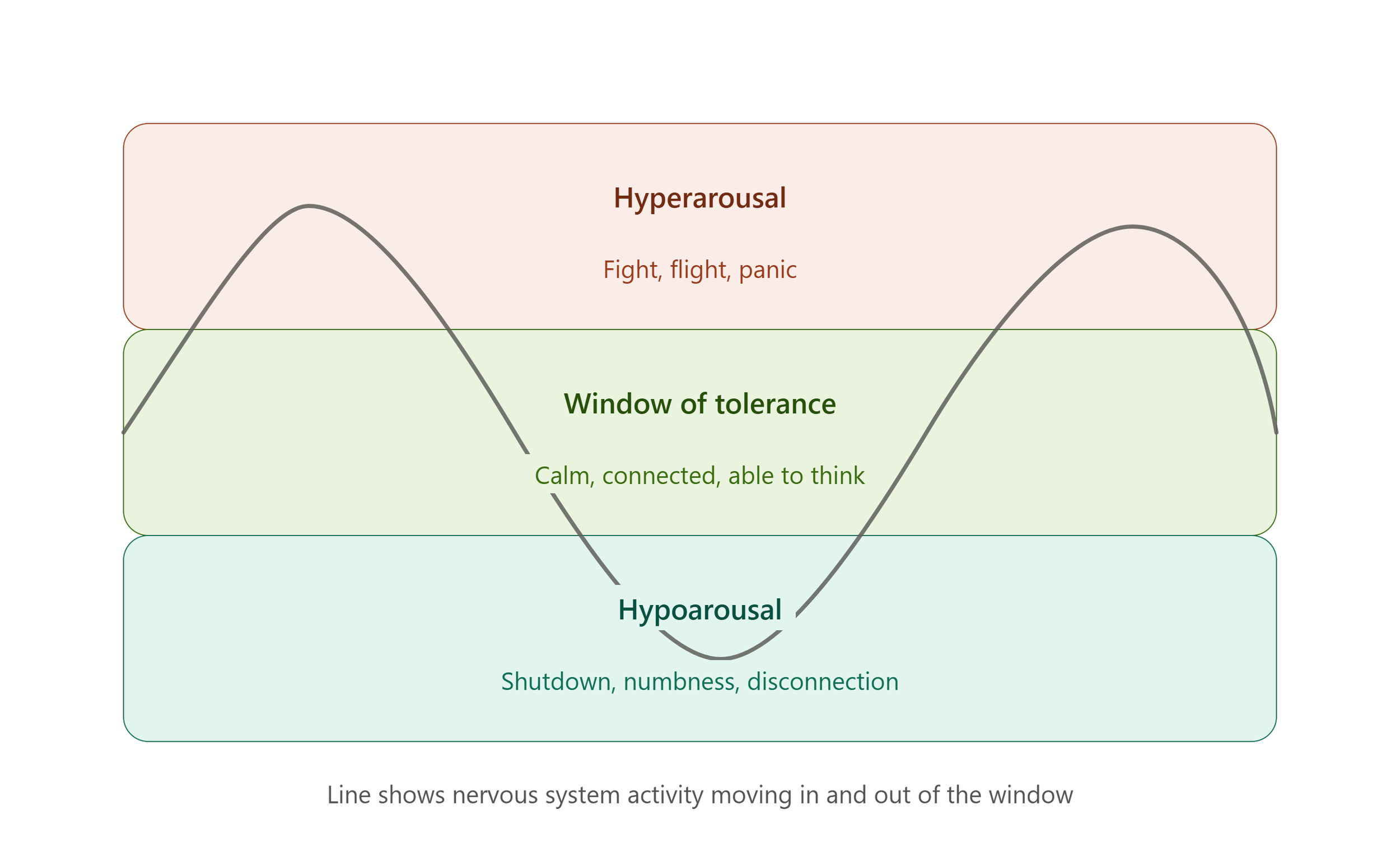
This shows the window of tolerance — a widely-used trauma-informed concept that explains why complex trauma affects emotional regulation. The middle band is where someone can think clearly, connect with others, and feel grounded. Trauma tends to narrow that window, making it easier to tip into hyperarousal (panic, reactivity) or hypoarousal (shutdown, numbness).
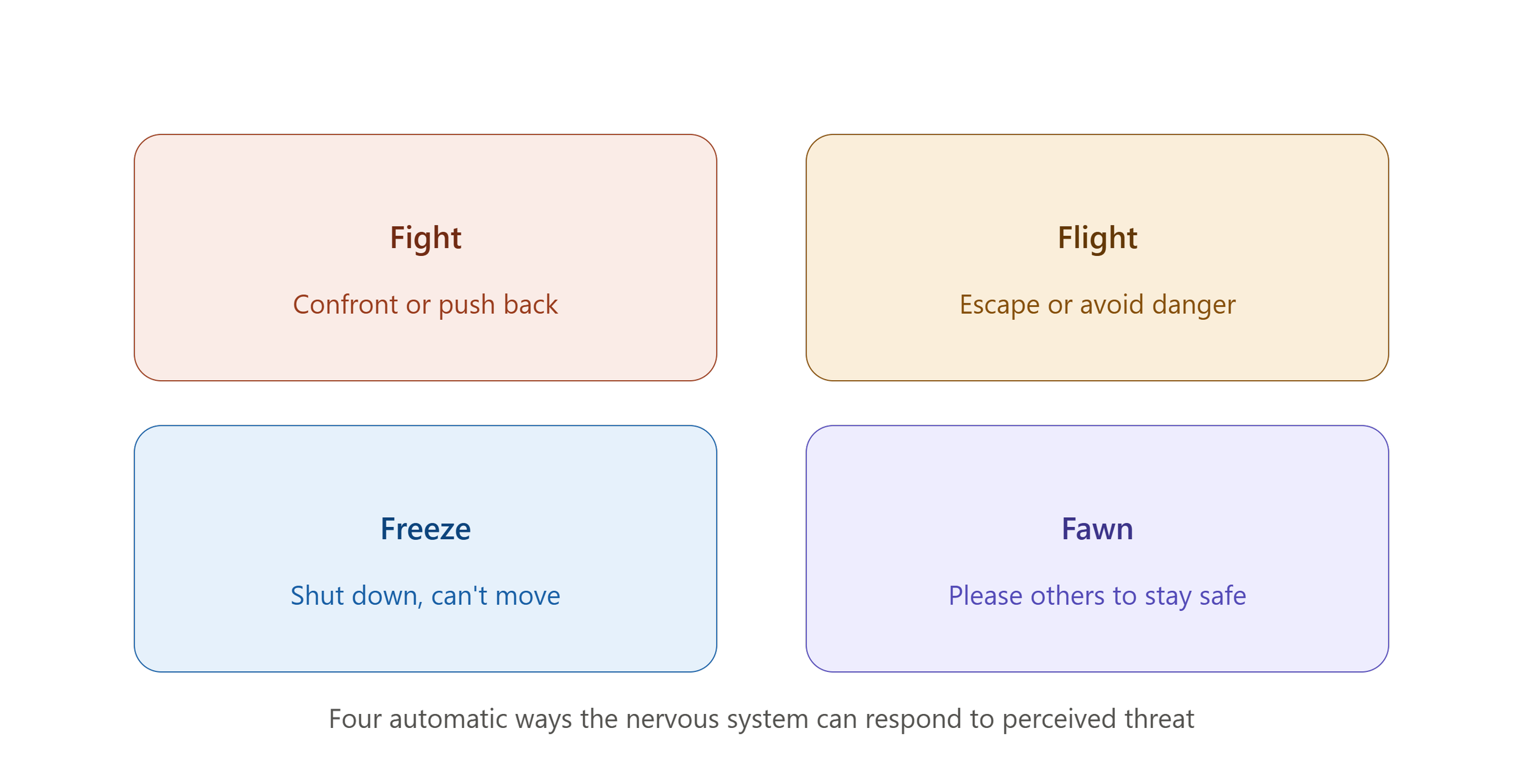
Four trauma responses (fight, flight, freeze, and fawn). Which one are you
How Trauma-Informed Therapy Can Help
Healing from complex trauma isn't about simply "talking through" difficult memories. It requires an approach that respects the way trauma lives in both the mind and the body. In my practice, I draw on several complementary, evidence-based modalities depending on what each client needs:
Cognitive Behavioural Therapy (CBT) helps identify and shift the negative thought patterns that often develop after prolonged adversity.
Acceptance and Commitment Therapy (ACT) supports clients in building a values-driven life, even alongside difficult thoughts and feelings, rather than waiting to "feel ready" first.
Dialectical Behaviour Therapy (DBT) skills offer practical tools for emotional regulation, distress tolerance, and healthier relationship dynamics — especially helpful for the emotional intensity complex trauma can bring.
Emotionally Focused Therapy (EFT) is particularly powerful for couples and families navigating how past trauma shows up in present-day relationships.
Trauma-informed somatic approaches recognize that trauma isn't only a "story" the mind tells — it's also held in the body. Gentle body-based techniques help clients build safety and regulation from the ground up.
As a Registered Psychotherapist (Qualifying) holding Complex Trauma Certifications (CCTP and CCTP-II), I integrate these approaches into a personalized treatment plan — never a one-size-fits-all protocol.
What Healing Can Look Like
Recovery from complex trauma is rarely linear, but with consistent, compassionate support, clients often notice meaningful shifts over time:
Feeling more grounded and less reactive in daily life
Recognizing old patterns before automatically repeating them
Building relationships based on trust rather than fear or control
A quieter, kinder inner voice
Reconnecting with a sense of identity outside of survival mode
Therapy isn't about erasing the past. It's about no longer letting the past run the show.
Flexible, Local Support Across Durham Region
I know that finding "the right therapist near me" can feel overwhelming, especially when you're already carrying a lot. That's why I offer multiple ways to access care, so therapy can fit into your life rather than adding more stress to it:
In-person sessions at my Whitby office (1117 Brock St S)
Virtual sessions available anywhere in Ontario
In-home sessions for clients who need additional accessibility or comfort
Walk-and-talk therapy for those who process best while moving, offered around Whitby and the surrounding Durham Region area
Whether you're located in Whitby, Oshawa, Ajax, Pickering, or Bowmanville, support is close by — and it's okay to ask for help, even if you're not in crisis. In fact, most of the people I work with aren't in crisis; they're simply tired of carrying something heavy alone.
Ready to Take the Next Step?
If any part of this post feels familiar, please know that healing is possible, and you don't have to figure it out on your own. I offer individual, couples, and family therapy for clients navigating the impact of complex trauma throughout Durham Region and virtually across Ontario.
Book a free consultation today through intentionalgrowth.ca or directly via intentionalgrowth.janeapp.com to see if we're a good fit.
Chelsea Smith is a Registered Psychotherapist (CRPO #17672) and owner of Intentional Growth Path Psychotherapy in Whitby, Ontario, holding Complex Trauma Certifications (CCTP/CCTP-II) and specializing in CBT, ACT, EFT, DBT, and trauma-informed somatic care.
