
7 Relationship Questions Couples Are Googling at 11 PM (and What a Therapist Says)
It's late. The house is quiet, or it's quiet in the way that feels loaded. You're on your phone typing something you'd never say out loud: "Why do we keep having the same argument?"
If that sounds familiar, you're far from alone. Every day, couples across Durham Region and beyond turn to search engines with questions about their relationship. Most of these questions have a real answer, and most of them are more fixable than they feel at midnight.
As a psychotherapist working with couples in Whitby, I hear these same questions in session all the time. Here are seven of the most common, with honest answers.
1. "Why do we keep having the same fight?"
Because the fight is rarely about the dishes, the phone, or the in-laws. It's about what's underneath: Do you see me? Do I matter to you? Can I count on you?
Many couples fall into a pursue-withdraw cycle. One partner pushes for connection ("We need to talk"), and the other pulls back to avoid conflict ("I need space"). The more one pursues, the more the other withdraws, and both end up feeling alone.
What helps: Stop trying to win the content of the argument. Name the pattern instead: "I think we're doing that thing again." Treating the cycle as the shared problem, rather than each other, lowers defensiveness fast.
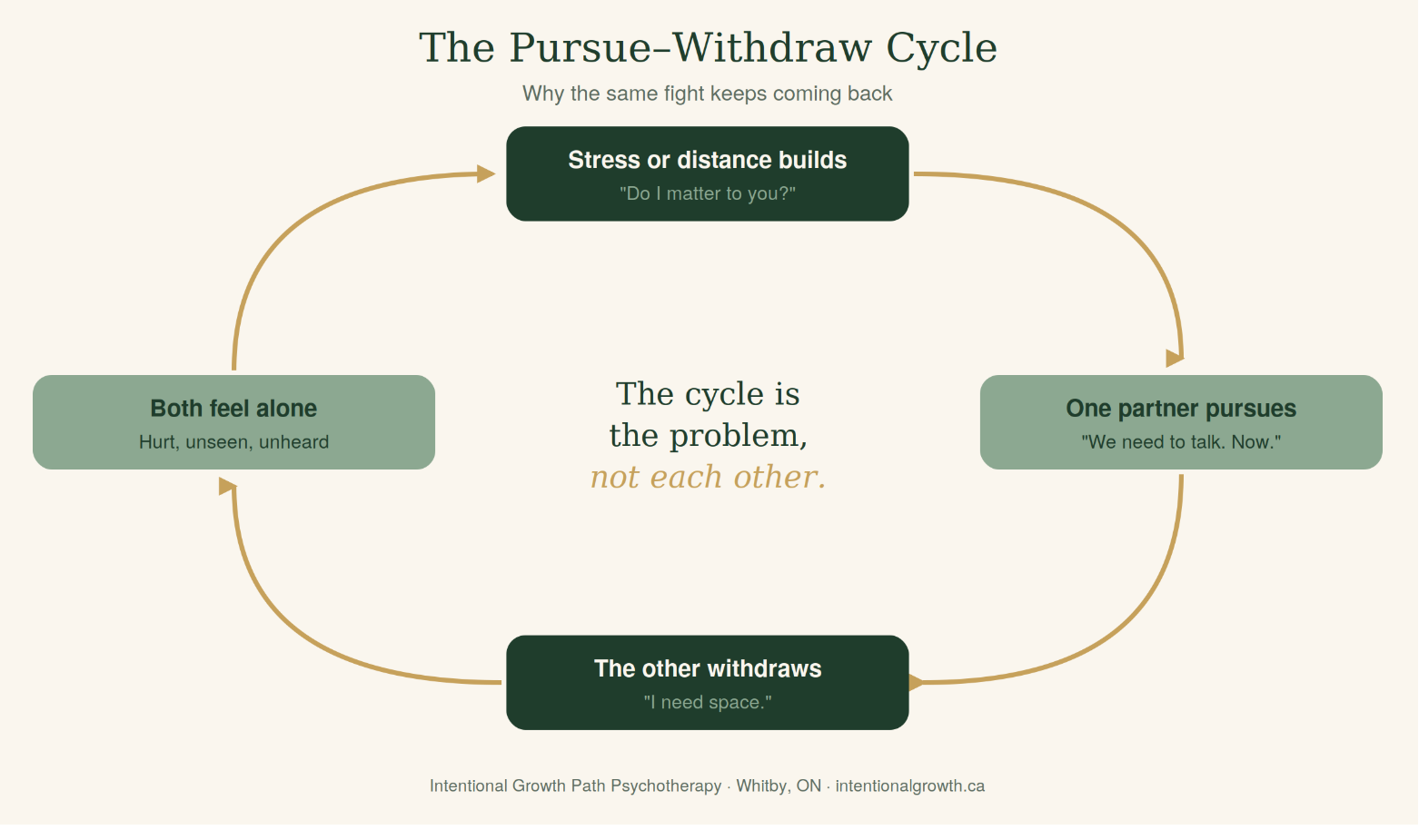
Diagram of the pursue-withdraw cycle in relationships: stress builds, one partner pursues, the other withdraws, and both feel alone.
2. "Is it normal to feel disconnected from my partner?"
Yes, and it's one of the most common reasons couples seek support. New babies, career stress, caregiving, money pressure, and long stretches of "logistics mode" can quietly turn partners into roommates.
Disconnection isn't a verdict on your relationship. It's usually a sign that connection has been crowded out, not that love is gone.
What helps: Small, consistent moments beat grand gestures. Try a 10-minute daily check-in with no phones and no problem-solving, just curiosity: "What was the hardest part of your day?"
3. "How do we communicate better without it turning into a fight?"
Good communication isn't about saying everything perfectly. It's about staying regulated enough to be heard. When your nervous system is in fight-or-flight, the thinking part of your brain goes offline, and no communication tip survives that.
What helps:
Pause before you escalate. Agree on a break signal and a time to return ("I need 20 minutes, and I'll come back to this").
Lead with the feeling, not the accusation. "I felt alone tonight" lands very differently than "You never listen."
Ask what your partner needs, not just what they did wrong.
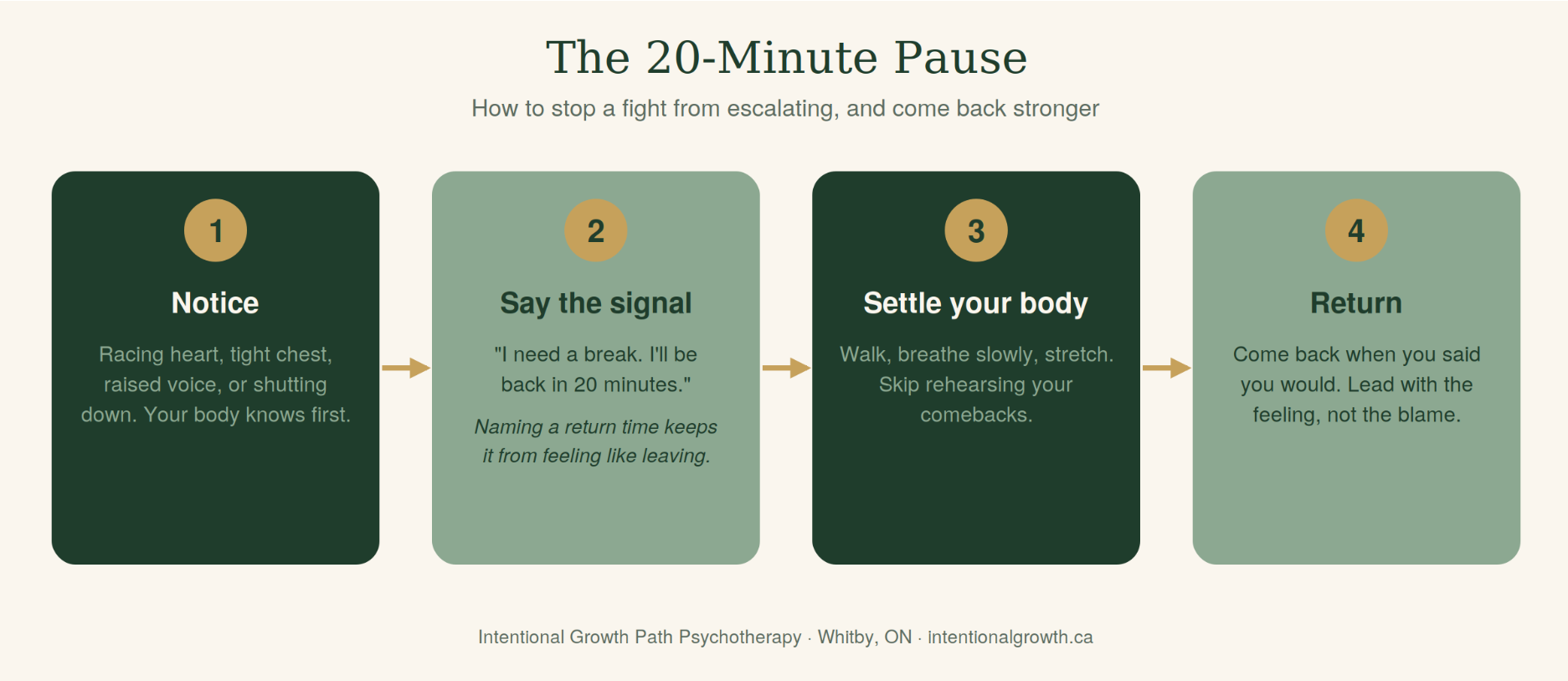
Four-step diagram for calming a couple's argument: notice your body's signals, say a break signal, settle your body, then return to talk.
4. "Is couples therapy worth it? Does it actually work?"
Research on approaches like Emotionally Focused Therapy (EFT) has shown strong results for helping couples rebuild connection. That said, therapy works best when both people are willing to be curious about their own part in the pattern.
A good couples therapist isn't a referee and won't take sides. The work is helping you both understand the cycle you're stuck in and build new ways of reaching for each other.
What to expect: Early sessions focus on understanding your story and your patterns. From there, you practise new ways of relating, in the room and between sessions.
5. "What are the signs we need couples therapy?"
You don't have to be on the brink for therapy to help. Consider reaching out if:
The same conflicts repeat with no resolution
You avoid difficult topics to keep the peace
One or both of you feels lonely inside the relationship
Trust has been damaged, by infidelity or by smaller breaches
Intimacy, physical or emotional, has faded
You're navigating a major transition (a baby, a move, a loss, blending families)
You're wondering whether to stay together
Waiting for a crisis is common, but earlier support usually means an easier road.
6. "How do we rebuild trust after it's been broken?"
Trust doesn't return through apology alone. It's rebuilt through consistent, transparent action over time, and through the hurt partner feeling truly heard.
Rebuilding usually involves honest accountability from the partner who caused the injury, room for the hurt partner's pain without rushing them to "move on," and new agreements that make safety visible again. It's slow, and it's absolutely possible with the right support.
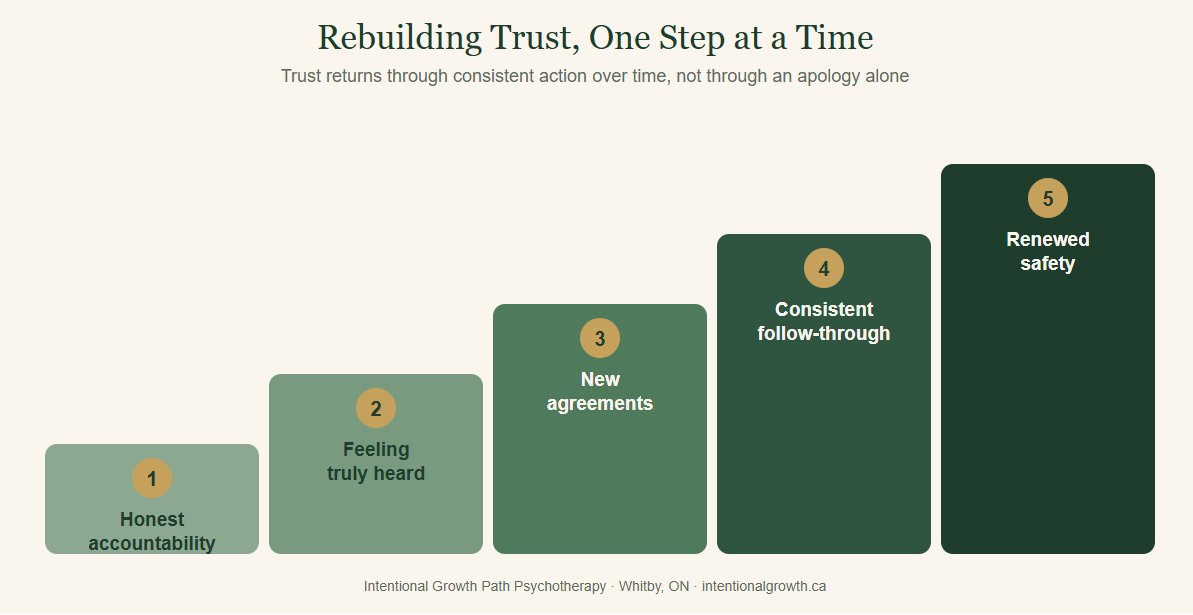
Five-step staircase diagram showing how couples rebuild trust: accountability, feeling heard, new agreements, follow-through, renewed safety.
7. "Are we just incompatible, or is this fixable?"
Every couple has differences: in how they handle stress, money, affection, or space. Compatibility isn't the absence of differences. It's the ability to work with them.
The more useful question is: Do we both feel safe enough to be honest, and willing to try? If yes, there's usually something to build on. If you're unsure, therapy can also bring clarity, including clarity about whether to stay or part, and how to do either with care.
When You're Ready for Support
Relationships are one of the most meaningful, and most tender, parts of our lives. You deserve support that meets you where you are.
At Intentional Growth Path Psychotherapy, I offer couples, individual, and family sessions in-person at our Whitby office (1117 Brock St S), virtually across Ontario, and even walk-and-talk sessions for people who open up more when they're moving. I draw on evidence-based approaches, including EFT, CBT, ACT, DBT, and trauma-informed practices, tailored to what you and your partner need.
Serving Whitby, Oshawa, Ajax, Pickering, Bowmanville, and all of Durham Region.
-
Fees vary by practitioner. Many extended health plans cover psychotherapy provided by a Registered Psychotherapist, so check your benefits. Session fees range from $175- $225, depending on an hour session or 90 minutes.
-
It varies with your goals and history. Many couples notice shifts within the first several sessions, and deeper patterns take longer.
-
Yes. Virtual sessions are available across Ontario and work well for most couples.
-
Individual sessions can be a valuable starting point, and sometimes they open the door for a partner to join later.
